’Tis the season for crèche display controversies and public-school decoration debates and First Amendment argumentation, when all the ideologues get a little extra outrage or victimization in their stockings. The holiday is observed across the nation with injunctions and festive debates on cable television. Little children wait in line at the mall to have their picture taken with Bill O’Reilly or the Rev. Barry Lynn. (That last part, to my knowledge, is not true, but it should be.) -- Michael Gerson, in a wonderfully thoughtful piece recently in the Washington Post
This can be seen as a "War on Christmas," but as I've said for years now, a more accurate a description comes from the title of Steven
Nissenbaum's history of the holiday,
The Battle for Christmas. It's not so much that we have a war
on
Christmas--most of the most liberal atheists I know celebrate Christmas in some form or another. Instead, as Gerson notes, "Ultimately all of these disputes resolve into an argument about power:
Who has the ability to define and enforce the boundaries of the
acceptable?" And this isn't new. Over the centuries, we've had a lively debate about what
Christmas is and isn't. And yes, through the years some people
have
wanted not to celebrate it at all (but mostly those people were
Christians--more on that later).

The date December 25
was taken for Christmas back in the 4th century, not because anyone had
evidence that this was the silentest, holiest night, but because
those crafty 4th-century Christians wanted to annex the pagan winter festival. From
the Roman Saturnalia onward Christmas was--and remained for many centuries--a time of drinking and
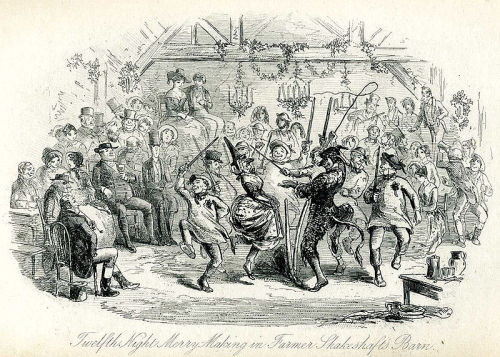
debauchery. In 16th-century England, this Christmas celebration was a festival of misrule, in which people boozed it up, and the
poor went door to door essentially demanding "trick or treat"--give us
good food or money or gifts or we'll wreck $#!+. Think of carols like
"We wish you a merry Christmas" and all its demands for figgy pudding and its assurance "we won't go until we get some,"
as well as all the wassailing songs and
their demands. "Here we
come a-wassailing," for instance, first reminds the listener that "We
are not daily beggars / That beg from door to door, / But we are
neighbors' children / Whom you have seen before"--and then they go on to
ask for money, cheese, some of the Christmas loaf, and (of course!) some
wassail. And in "Wassail, wassail," after they spend innumerable verses
building up the master of the house, they get to the point, asking for
drink and to be let in by the fire:
Come, butler, come fill us a bowl of the best
Then we hope that your soul in heaven may rest,
But if you do draw us a bowl of the small
Then down shall go butler, bowl and all!
Blessings are given to those who give, curses to those who are stingy or unobliging.
There's even a certain logic to this kind of thing, when we recall the way that the birth and life of Jesus inverted the social order--a "king," as he was styled, or even an aspect of
God, born into an animal stall and ministering to the poor, the wretched, the outcast. A celebration that reversed the social hierarchy might be appropriate enough to celebrate the birth of Jesus.
The holiday as a
festival of misrule was basically accepted by the upper classes, too, as
a sort of pressure valve for the lower classes. The social hierarchy is
inverted once a year: no big deal. The wealthy would get angry with
particular wassailer or particular acts (the common folk could get pretty rowdy and
destructive if their demands weren't met!), but overall the drinking and
singing and demands for food and drink and gifts were tolerated.
For
exactly this reason, Christmas had a hard time making its way across
the pond, no matter how appropriate it may have been in its own way. The Puritans outlawed Christmas on the basis of its nature as a
holiday of drinking and debauchery, as well as on the argument that the
Bible doesn't indicate when Jesus's birthday was, thus God has no
interest in having us celebrate it. Nonetheless, people rather like an
excuse to drink and revel, especially in the bleak midwinter, so it
continued on the edges of legality in New England and had a bit more
success in other parts of the country.

Even hundreds of years ago, we had a battle over how--or even
whether--Christmas should be celebrated, and arguably the most devout Christians were the ones fighting a "war on Christmas." However, since even the most puritanical of Puritans couldn't
end Christmas, it
ultimately ended up tamed by a rather unlikely force.
In
the mid-to-late Nineteenth Century, retail stores were just starting
to take off. Standardized manufacturing was just getting going on a
large scale, and retail stores were outlets for all these material
goods. The problem? The so-called
Protestant Work Ethic was firmly entrenched in America. That is, people worked hard, saved their money,
and didn't buy crap they didn't need. Retailers knew this would never
do, so they are the ones who took the largest steps toward inventing--yes, inventing--the
Christmas holiday as we know it. They made Santa Claus big (okay, years
of cookies and whole milk did
that) and they marketed
Christmas as a time of love and good-will and--you probably guessed it--gift
giving. They employed writers to create the stories that presented this
kind of Christmas. They made people nostalgic for a type of Christmas
that hadn't even existed before: a warm, cheery, wholesome holiday--and
it
became precisely that. The St. Nicholas mythos got drawn into it (St. Nick got pulled to Christmas from his normal place at--duh--the feast of St.
Nicholas in early December). And some of our ideas were just flat-out made up. In the
process, Christmas went from being a public holiday to a private one,
from one celebrated in the streets with the community to one celebrated
at home with the family. From a drunken revel for adults it became a child-centered holiday of gift giving.
I didn't get much further in
the book, but I reckon it likely that, once commercial forces had
sanitized Christmas and made it good and pure, Christianity decided it
was high time to get back in the Christmas game, and they set about
re-holy-daying it. That is, they claimed it for their own now that it
was a wholesome time. And who can blame them? It's a nice little
holiday.
But, of course, retailers did their job too
well. We've gone from the protestant work ethic to the consumerist spend
ethic, and whether we work enough or not, by Visa we can spend! We
don't just spend the money we have, we spend the money we
will have, which is just a more positive way of saying
the money we haven't.
As the culture has changed and become more materialistic, so too has
the holiday become ever more materialistic. Religion, naturally enough,
fights against this tendency (we're reminded that "Jesus is the reason
for the season," i.e. not Santa Claus or gift-giving). So, too, do more
secular types who nonetheless see something negative in crass
materialism.
Secular though I may be, I have at least
that much spiritualism that I mistrust unchecked materialism--even as I
enjoy the hell out of a limited degree of it. Because yes, I like stuff,
just like most Americans do. But--I think like most Americans here too--not to the exclusion of all else, and
not beyond a certain point. There's a limit to how much stuff any person
needs, and there are a lot of things more important than stuff. As long
as we don't lose sight of
those philosophical touchstones,
gift-giving during this season is a wonderful, wonderful thing.
Gift-giving is--to steal a phrase--an outward and visible sign of an
inward condition. It's most meaningful when it comes from the heart and
speaks to the heart, when it's freely given and not expected as a duty.
For
me, Christmas isn't a religious holiday, though they're welcome to keep
claiming it. It's a social institution that's evolved through many
different forms and ultimately is--or will be--whatever we make of it.
Although the name and its origins and history put a distinctly Christian stamp on it, our brief
look at its history shows us what an uneasy time religion has had
throughout the centuries in trying to claim it. That's why I say it's a
social institution: it has shaped our culture and been shaped
by
our culture, and anyone who participates in that culture, it seems to
me, has a claim on that tradition in whatever form they choose to stake
that claim. Further, though it's not precisely true to say that America "is a Christian nation," it's certainly a nation in which Christianity has been essential in its history, and as a result even many in America who are secular in their outlook could be considered "secular Christians" or at least influenced by the culture of Christianity.
There was a festival at the winter solstice before
Christianity claimed it by naming it Christmas, and I'd wager that in
many places there was such a celebration long before Jesus was born. We
need a
holiday at this time of year, which is probably why many religious
traditions--as well as non-religious traditions--have a holiday at this
time of year. I suspect that even if something happened that caused
everyone to cease believing in Jesus, we'd probably still celebrate
Christmas, because it's just the sort of thing we want.
Never has that been more true for me than now, when I have two little girls: the magic of Christmas has become for many of us the
magic of childhood, as we adults are fueled by their excitement. And
really, both of our mythologies speak to this reverence for childhood,
whether it's the story of Santa Claus bringing toys to good little girls
and boys or the story of a child born in humble circumstances and
destined to change the world.
-----------------------------------------
In the interest of full disclosure, I should say two things: 1) this is based almost exclusively on Nissenbaum's
The Battle For Christmas and 2) I've published versions of this in four previous years on this and my former blog.