Showing posts with label history. Show all posts

Thursday, December 26, 2013

The Church in the Wildwood


There’s a church in the valley by the wildwood,
No lovelier place in the dale,
No spot is so dear to my childhood
As the little brown church in the vale.
-- William S. Pitts

 Okay, the church that we went to Sunday was surrounded by corn-stubble fields made recently into impromptu lakes by two days of continuous rains, not woods—wild or otherwise—and here in northern Ohio, valleys are distant rumors. But still, it’s fair to say that few spots from my childhood are as dear as Zion U.C.C., in Fireside (a spot you probably won’t find on a map). 

Going there at least once a week for the first eighteen plus years of my life, there’s probably nowhere other than my childhood home that I spent more time. Walking into the sanctuary yesterday, much was familiar—the same Christmas banners were hung along the sides (they could easily be 40+ years old, but they look the same as I remember them), the same hymnals are in the same pews (they were upholstered while I was growing up, so I also remember them as bare wood), the same altar, the same lectern and pulpit, the same carpet and the same stain-glass windows.

And quite a few of the same people—familiar old faces lit up when they saw me with my mother and my oldest daughter. There was no one from my generation there, just the parents and grandparents of our generation. Of course, those were some of the adults I most respected as a child and young man. Some from that generation are no longer with us, but it was a delight to see the ones I did.

There were also changes--they've been through a few ministers since I left, there was a new organ down by the lectern where a piano used to be, instead of above the back of the sanctuary, and a grand piano on the other side, by the pulpit, and there were large screens at the front and back of the sanctuary (though there wasn't much of import up there).


I was there to hear your borning cry,
I’ll be there when you are old.
I was there the day you were baptized,
To see your life unfold.
--John C. Ylvisaker

The minister asserted--against all the obvious evidence to the contrary--that “I was there to hear your borning cry” is one of the most beautiful hymns ever written, as she prepared to baptize a father and daughter yesterday. As it happens, the father was a classmate of mine in school, though he just recently started going to my childhood church. His daughter is not quite four months old.


But it was perhaps all the more striking to me that all the people who graduated from high school with me--there were more than a half dozen of us just in my class--and those who graduated in the years before and after mine--my generation is otherwise completely absent.

I realized recently that my family's ties to this church are deep--I'm relatively confident that I've understood the historical record to say that one of my ancestors back in the 1800s played a big role in building the church (or, anyway, the church that became this church--it burned down sometime in the mid-20th Century). Something like five generations--that's a guess, I'm too lazy to look it up this morning. But I don't go there any more. From what I could see, a lot of the older people in the church were people that have known me all their life and been more or less life-long members, and there are some younger families there too, but by and large the younger and middle-aged folks there all seem to be new. Which is great for the congregation--with so many people of my generation leaving our small town, they have to bring in new members to survive, but there's also something that sees it as unfortunate that families that have been part of the church's history for generations have left and been replaced with entirely new people.

Maybe that song, "I was there to hear your borning cry" played into those thoughts, as it speaks to the continuity in one's life and from generation to generation that God, theoretically, provides.  I shouldn't be surprised if it generations some nostalgic feelings in me, some vague desires for a past that's gone--after all, it's the greatest hymn ever written.

Wednesday, December 25, 2013

Christmas Wars and Battles Through the Ages

’Tis the season for crèche display controversies and public-school decoration debates and First Amendment argumentation, when all the ideologues get a little extra outrage or victimization in their stockings. The holiday is observed across the nation with injunctions and festive debates on cable television. Little children wait in line at the mall to have their picture taken with Bill O’Reilly or the Rev. Barry Lynn. (That last part, to my knowledge, is not true, but it should be.) -- Michael Gerson, in a wonderfully thoughtful piece recently in the Washington Post
This can be seen as a "War on Christmas," but as I've said for years now, a more accurate a description comes from the title of Steven Nissenbaum's history of the holiday, The Battle for Christmas. It's not so much that we have a war on Christmas--most of the most liberal atheists I know celebrate Christmas in some form or another. Instead, as Gerson notes, "Ultimately all of these disputes resolve into an argument about power: Who has the ability to define and enforce the boundaries of the acceptable?" And this isn't new. Over the centuries, we've had a lively debate about what Christmas is and isn't. And yes, through the years some people have wanted not to celebrate it at all (but mostly those people were Christians--more on that later).

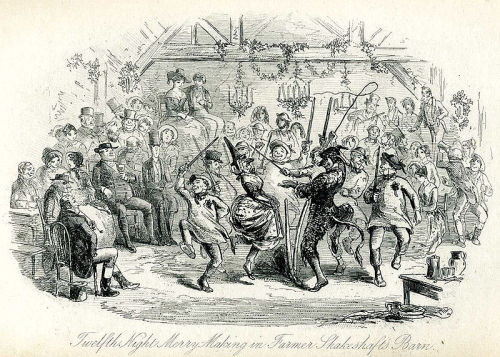
The date December 25 was taken for Christmas back in the 4th century, not because anyone had evidence that this was the silentest, holiest night, but because those crafty 4th-century Christians wanted to annex the pagan winter festival. From the Roman Saturnalia onward Christmas was--and remained for many centuries--a time of drinking and debauchery. In 16th-century England, this Christmas celebration was a festival of misrule, in which people boozed it up, and the poor went door to door essentially demanding "trick or treat"--give us good food or money or gifts or we'll wreck $#!+. Think of carols like "We wish you a merry Christmas" and all its demands for figgy pudding and its assurance "we won't go until we get some," as well as all the wassailing songs and their demands. "Here we come a-wassailing," for instance, first reminds the listener that "We are not daily beggars / That beg from door to door, / But we are neighbors' children / Whom you have seen before"--and then they go on to ask for money, cheese, some of the Christmas loaf, and (of course!) some wassail. And in "Wassail, wassail," after they spend innumerable verses building up the master of the house, they get to the point, asking for drink and to be let in by the fire:
Come, butler, come fill us a bowl of the best
Then we hope that your soul in heaven may rest,
But if you do draw us a bowl of the small
Then down shall go butler, bowl and all!
Blessings are given to those who give, curses to those who are stingy or unobliging.


There's even a certain logic to this kind of thing, when we recall the way that the birth and life of Jesus inverted the social order--a "king," as he was styled, or even an aspect of God, born into an animal stall and ministering to the poor, the wretched, the outcast. A celebration that reversed the social hierarchy might be appropriate enough to celebrate the birth of Jesus.


The holiday as a festival of misrule was basically accepted by the upper classes, too, as a sort of pressure valve for the lower classes. The social hierarchy is inverted once a year: no big deal. The wealthy would get angry with particular wassailer or particular acts (the common folk could get pretty rowdy and destructive if their demands weren't met!), but overall the drinking and singing and demands for food and drink and gifts were tolerated.

For exactly this reason, Christmas had a hard time making its way across the pond, no matter how appropriate it may have been in its own way. The Puritans outlawed Christmas on the basis of its nature as a holiday of drinking and debauchery, as well as on the argument that the Bible doesn't indicate when Jesus's birthday was, thus God has no interest in having us celebrate it. Nonetheless, people rather like an excuse to drink and revel, especially in the bleak midwinter, so it continued on the edges of legality in New England and had a bit more success in other parts of the country.

Even hundreds of years ago, we had a battle over how--or even whether--Christmas should be celebrated, and arguably the most devout Christians were the ones fighting a "war on Christmas." However, since even the most puritanical of Puritans couldn't end Christmas, it ultimately ended up tamed by a rather unlikely force.

In the mid-to-late Nineteenth Century, retail stores were just starting to take off. Standardized manufacturing was just getting going on a large scale, and retail stores were outlets for all these material goods. The problem? The so-called Protestant Work Ethic was firmly entrenched in America. That is, people worked hard, saved their money, and didn't buy crap they didn't need. Retailers knew this would never do, so they are the ones who took the largest steps toward inventing--yes, inventing--the Christmas holiday as we know it. They made Santa Claus big (okay, years of cookies and whole milk did that) and they marketed Christmas as a time of love and good-will and--you probably guessed it--gift giving. They employed writers to create the stories that presented this kind of Christmas. They made people nostalgic for a type of Christmas that hadn't even existed before: a warm, cheery, wholesome holiday--and it became precisely that. The St. Nicholas mythos got drawn into it (St. Nick got pulled to Christmas from his normal place at--duh--the feast of St. Nicholas in early December). And some of our ideas were just flat-out made up. In the process, Christmas went from being a public holiday to a private one, from one celebrated in the streets with the community to one celebrated at home with the family. From a drunken revel for adults it became a child-centered holiday of gift giving.

I didn't get much further in the book, but I reckon it likely that, once commercial forces had sanitized Christmas and made it good and pure, Christianity decided it was high time to get back in the Christmas game, and they set about re-holy-daying it. That is, they claimed it for their own now that it was a wholesome time. And who can blame them? It's a nice little holiday.

But, of course, retailers did their job too well. We've gone from the protestant work ethic to the consumerist spend ethic, and whether we work enough or not, by Visa we can spend! We don't just spend the money we have, we spend the money we will have, which is just a more positive way of saying the money we haven't. As the culture has changed and become more materialistic, so too has the holiday become ever more materialistic. Religion, naturally enough, fights against this tendency (we're reminded that "Jesus is the reason for the season," i.e. not Santa Claus or gift-giving). So, too, do more secular types who nonetheless see something negative in crass materialism.

Secular though I may be, I have at least that much spiritualism that I mistrust unchecked materialism--even as I enjoy the hell out of a limited degree of it. Because yes, I like stuff, just like most Americans do. But--I think like most Americans here too--not to the exclusion of all else, and not beyond a certain point. There's a limit to how much stuff any person needs, and there are a lot of things more important than stuff. As long as we don't lose sight of those philosophical touchstones, gift-giving during this season is a wonderful, wonderful thing. Gift-giving is--to steal a phrase--an outward and visible sign of an inward condition. It's most meaningful when it comes from the heart and speaks to the heart, when it's freely given and not expected as a duty.

For me, Christmas isn't a religious holiday, though they're welcome to keep claiming it. It's a social institution that's evolved through many different forms and ultimately is--or will be--whatever we make of it. Although the name and its origins and history put a distinctly Christian stamp on it, our brief look at its history shows us what an uneasy time religion has had throughout the centuries in trying to claim it. That's why I say it's a social institution: it has shaped our culture and been shaped by our culture, and anyone who participates in that culture, it seems to me, has a claim on that tradition in whatever form they choose to stake that claim. Further, though it's not precisely true to say that America "is a Christian nation," it's certainly a nation in which Christianity has been essential in its history, and as a result even many in America who are secular in their outlook could be considered "secular Christians" or at least influenced by the culture of Christianity.

There was a festival at the winter solstice before Christianity claimed it by naming it Christmas, and I'd wager that in many places there was such a celebration long before Jesus was born. We need a holiday at this time of year, which is probably why many religious traditions--as well as non-religious traditions--have a holiday at this time of year. I suspect that even if something happened that caused everyone to cease believing in Jesus, we'd probably still celebrate Christmas, because it's just the sort of thing we want.

Never has that been more true for me than now, when I have two little girls: the magic of Christmas has become for many of us the magic of childhood, as we adults are fueled by their excitement. And really, both of our mythologies speak to this reverence for childhood, whether it's the story of Santa Claus bringing toys to good little girls and boys or the story of a child born in humble circumstances and destined to change the world.
-----------------------------------------
In the interest of full disclosure, I should say two things: 1) this is based almost exclusively on Nissenbaum's The Battle For Christmas and 2) I've published versions of this in four previous years on this and my former blog.

Sunday, December 15, 2013

On the Genealogy of Morals


Fair warning, this is going to be a bit rambling and inconclusive. Enter at your own risk. 

It seems to me, in my—granted—limited study of the matter, that in genealogy, we tend to focus on genetic lineage: who begat whom, on down through the generations. This genetic transmission can be hard enough to track, but even more interesting to me is the memetic transmission down the generations--the beliefs, ideas, cultural practices of families. It’s amazing to think that the beliefs, the habits, of some of my ancestors may have persisted through the years, in ways that I’m not even aware. Some of it, maybe most of it, has been lost (same thing with genes, though), but it seems reasonable to think that the way my mother raised me was influenced by the way her parents raised her, and they were influenced by their parents, and on and on back through the years. No doubt about it though: beliefs, practices, and ideas are harder to track than names and places, unless one had an ancestor or ancestors who were writers (in one form or another). Maybe a public figure, maybe just private correspondence. But as far as I know, there’s none of that in my family--I mean, I'm sure there were private correspondences, but they haven't been saved and come down to us.

One meme complex that is somewhat easier to track through the ages than others is religious belief, if only because religions are complexes of memes that we put names on and that manage to get recorded in the historical record. As I’ve seen even in my limited research, religious affiliation is  something that gets written down. Casper Sherck, my first ancestor in America, came to this country along with other Anabaptists because they were persecuted in Europe, and obviously a religious belief that is held onto despite persecution must be important. Casper Sherck III was a minister who started the Church of the Brethren--to not only be a minister but also to be part of a new religious movement? That suggests that the ideas were pretty important to him. And I see in a history of the county where I grew up--and where my ancestors lived for over 100 years--that one relative gave money for the building of a church (which I think is actually the church I grew up going to), while another ancestor is noted as "an active member" of that same church.These are elements of a person's intellectual life that got recorded in ways that few other memes did.

We can't assume, of course, that anyone in the past was either necessarily or perfectly orthodox in his or her belief just because he or she went to a particular church. Just look at people today: identifying the church someone attends doesn’t necessarily tell us everything we would want to know about the person--or even about that person's religious beliefs. I think there’s a part of me that would like to assume that people were more homogenous within a particular belief system, either because the religions were better at enforcing orthodoxy back then or because people just weren’t as cross-culturally contaminated as we are today, but to do so would be to ignore the independent-mindedness that human beings so often display. We’re all sheep in some ways, but we’re all bulls or donkeys or some kind of stubborn critter in other ways. 

Still, I do suspect that religious affiliation may tell us more about people in the past than it would today, particularly for those of our ancestors who came to America specifically for religious reasons. These religious beliefs would seem to be central to a family's identity, at least in the first generations.

Even separate from my own ancestors, this got me thinking about the way that religions--and their adherents--must have come into contact with on another back in the 1700s in certain parts of America (of course, we're pretty much talking about different Protestant denominations, back then). There were certain places where a particular religious group was basically able to establish a state religion, like Massachusetts with the Puritans, who basically outlawed groups like the Quakers, and as we move through the American Revolution, I was just hearing yesterday how Massachusetts and at least one of the other original states had what amounted to a state religion at the time (I think it was Congregationalism in both of them, but I could be wrong). But in other places, this wasn't the case. I ran across a book--I couldn't read it, but I saw that it exists--about religious pluralism in Lancaster County, PA in the 1700s--which is basically where my Sherck ancestors were at that time. 

And I think it's easy to see how, in that kind of religious context, my ancestor who was a minister could end up part of the religious upheaval that ended up in a new denomination. In close proximity, you have all of these people who are ultra-serious about their religious beliefs, and none of them can force their beliefs on anyone else, so you'd imagine there's a lot of religious dialog. And sometimes, people who are serious about religion, can change their minds because they're ultimately more interested in seeking the Truth (as they understand it) than in adhering to the tenets of their religion (which, I suppose, both makes my point and undermines it--makes it because it shows the importance of religion in these people's lives, but also suggests that we can't expect doctrinal conformity). 

Sunday, March 25, 2012

Religion: more harm or more good for humanity?

One of my atheist Friends on Facebook likes to post questions and links that stir the pot between believers and non-believers (full disclosure: I don't actually know him in real life, but a mutual friend connected us, and I do enjoy reading his posts and the conversation they provoke).

Last night, he raised the question "Has religion done more harm or good for humanity?" I put some serious thought into this question a little over six years ago, and haven't really touched it since, but now seems like as good a time as any to do so. I have often argued the "more harm" side, but perhaps that's just because so many believers seem so reluctant to acknowledge the dark side of religion. But the more I think about the question as a whole, the more ambivalent I become.

Let's start with a back-of-an-envelope argument that religion has done more harm than good. The crusades, the inquisition, the persecution of the Jews, modern Islamic terrorism the world over, religious persecution of gays or those seeking (or providing) abortions, to say nothing of electing and re-electing George W. Bush: All of these things could reasonably be attributed to religion, along with all kinds of more personal atrocities.

Believers could point to such things as the end of slavery in America or the progress of civil rights as progress inspired by religion. Or, conversely, they could make the analogy that overtly-secular forces such as Soviet Communism are responsible for massacres as horrendous as anything religion has set up; atheists would respond that those atheists aren't representative of all atheists, to which believers might respond: "precisely, and the believers who committed the other acts you cite don't represent all believers, either."

A book--or, perhaps, an encyclopedia--could be written on this argument (from the "harm" side, at least one has been--God is Not Great by Christopher Hitchens). But ultimately, that's simply a catalog of atrocities committed in the name of religion. It should give pause to those who consider religion to be an unalloyed good, but it doesn't answer the question.

What can religion take blame and credit for?When we talk about such things as the Crusades or the conflict in Palestine, or the conquest of the Americas (which were frequently seen in religious terms), it could reasonably be argued that such events were in reality political conflicts of one sort or another which were simply justified by religion and that, absent religion, they would still have been "justified" by other rationales (racial inferiority, simple hatred of "the other," whatever). Many of these things can also be seen as reactions to population pressure, to economic forces, or simple avarice on the part of leaders, with religion simply the icing on the cake that made it palatable to the people. This function of religion can't be neglected, because it's still a negative that religion can be used this way, but--to use a metaphor--religion might simply be chocolate icing which could have been replaced with vanilla or cream cheese or what have you (much as Maxism or racism was used elsewhere and otherwhen).

By the same token, however, the positives of religion could reasonably be taken away from religion. If it helped end slavery in the US, we can also remember that religion helped justify that same slavery in the south and historically. And we could argue that secular forces (industrialization making slavery less necessary, a higher standard of living raising the consciousness of the suffering of others) also played into such movements and that secular forces might have done the job just as well (for instance, if the Enlightenment project hadn't been set back by religious forces).

Thus it seems like the arguments that help absolve religion of blame can also be turned around to absolve it of virtue. Call it a push?

When it comes down to it, the two positives that religion might legitimately be said to offer are hope and morality.

The Case for Hope
Religion offers at least two kinds of hope. One, of course, is the hope of life after death (which helps enforce morality, whether that morality includes being nice to children and puppies or slaughtering infidels) which for some people seems to make life seem more meaningful, even though its effect is actually frequently to de-value this life. More, though, it offers hope that life is inherently meaningful, that there's a reason to go on living. Likewise, though, the belief in religion allows people to believe in ultimate justice of all sorts: that bad people are punished and that our good actions will be justified. It gives us hope that our small contributions to larger movements will be successful: either God will help us or God will ensure that our contribution to a cause is justified in the long run. Consider, for example, people struggling against oppression. An unbeliever might not participate in resistance because of a belief that they can't make a difference, whereas a believer might find courage in their belief that God will support them or, at the very least, make their suffering and/or death not be in vain.

Now, of course, there are some arguments against these points. Religion isn't needed to make life meaningful. Or, on the other side. people may rely on God to solve their problems rather than acting themselves. And, likewise, a person following secular beliefs could realize that seemingly impossible things have been accomplished by collective action, justifying their risk to contribute. Nonetheless, believing that God will help a just cause is far different than believing that people could succeed against the odds. Flip that around though: history shows us that people also can die based on religious beliefs in the service of losing causes and unjust causes, and in these cases religion gave them the strength and confidence to do things which might have been better off not being done!

How about morality?
In the first place, it's certainly possible to be moral without believing in religion--or to be immoral while believing in religion. Perhaps religion does do a better job of enforcing moral codes--the beliefs so engendered tend to stick better and be more deeply held.

None of this is particularly surprising, when we considered how religion developed alongside more complicated social structures. The rise of "civilization" over tribal living is deeply tied to the rise of religion. In tribal life (small communities with close ties among its members), morality is relatively easy to enforce. Shaming is very effective in such groups and, if worse comes to worse, the community at large can physically force adherence to rules.

In larger social grouping such as cities and states, this sort of community no longer exists. People no longer necessarily know their neighbors and they come in contact with all sorts of people. In this case, the enforcers of morality become two-fold: laws which are backed up by the state and morals which are backed up by religion. Laws suffer from the limitation that no government can effectively police all of its citizens; plus, the state is essentially reactive in enforcing its laws, and imperfect at that. Thus, the importance of religion. If people believe that something is wrong, if they believe that breaking a rule will not just be punished by their community or state if they're caught but instead will be punished by their god(s), they are somewhat more likely (though not assured) of following these rules.

Now, this is all historical, of course. I've already asserted that atheists can be moral, and I have no reason to go back on that statement. But it's equally clear that they may very well not be. The common "If there's no God, then anything is allowed" is too easy to accept by those who have not particularly thought on the matter. Here's where our beliefs about human beings will ultimately come into play. A pessimistic view would suggest that, in fact, the majority of human beings (or, at least, a significant number) can't (or won't) be moral without the fear of God hanging over them. Thus, for society, religion might be a good thing. This isn't to say that it is good for all members of society, just for society as a whole, to keep people good and to unify a large, diverse population. A more optimistic view would hold that the reason that it seems like people can't all (or mostly) be good have to do with their education and beliefs, and so can be corrected. This is a pretty big question--bigger, in fact, than I want to try to dig into today, even though it's essential to the question. If people are basically bad, then religion (or something like it?) might be necessary for social order; if people are basically good, then religion might not be necessary and therefore not necessarily good.

Less good or bad than inevitable?
In response to a similar post some six years ago, my friend Matt wrote:
By asking whether religion is good or bad for humanity, you're essentially asking whether humanity is good or bad for humanity. (My answer: on the whole, it's a slight negative.)
I'm not saying religion is genetically hard-wired into us, but I am saying that every single conceivable consequence of it, from holy wars to those little tiny envelopes they make for Sunday School donations, would come about in roughly the same way for other reasons in its absence. It's here, it may or may not be queer, get used to it. Human beings have a limited number of responses to stimuli, and they're always going off, all over the place, all the time. We could as easily get rid of (or more deeply ingrain) legal codes, fungi, left-handedness, or ennui.


Perhaps that's true--in a way, it anticipated Alain de Botton's Atheism 2.0, which has the basic premise that, because of human nature being what it is, atheists can learn a thing or two from religion, which after co-evolved socially with human beings. We might be able to imagine other ways of dealing with the problems that religion deals with, but in a way it's difficult to see what the options were because, in a sense, the weight of history is saying that they weren't--for one reason or another--viable options, which is particularly true because "organized religion" wasn't chosen by King So-and-So in 10,000 BCE or whatever: it was "chosen" on a cultural level over and over.

That said, it's still an open question whether organized religion should continue to be an important force in the world, and it may very well be a question which our culture is answering in the negative--look at all of the "spiritual-but-not-religious" folks out there. The relevance of the question, really, is whether the good of religion outweighs to evil of religion such that it should continue in the present and future. Or could other belief systems do as well or better? 
 Religions don't kill people; people (with religions) kill people
A virtual friend who's long since disappeared made an analogy that clarified my thinking a bit, likening religion to a loaded gun, she suggested that it's not religion which is at fault so much as it is what people do with religion that raises difficulties. To her conclusion that "religion is unquestionably good, in the hands of GOOD PEOPLE," I feel compelled to add that religion is unquestionably bad in the hands of bad people. That's the thing: religion is incredibly powerful. Likening religion to a gun may have been an understatement--try a missile or even a nuke!

What gives religion so much power is its absolute nature: when a priest or pope or imam says "this is the right thing to do," it is theoretically God saying that it's the right thing to do. Rules are backed up with infinite punishment or infinite reward, and thus can trump everything, including--or especially!--common sense. Thus do people fly airplanes into buildings or strap bombs on as they head to the subway; thus do people Crusade to take back "holy lands" or torture those who disagree and get away with it. They get away with it because they're seen as fundamentally and absolutely right. This is religion's great power for good and evil. Not its only power, but probably its greatest.

That doesn't happen just in religion, of course, but it seems to me that religion is a more powerful force as a justifying motivation. In Soviet Russia or Communist China, there was significant resistance--overt, covert, and silent--because the secular regimes couldn't justify their abuses beyond the naked use of power to do what they wanted. Religion seems to be a more believable uniting fiction, in the sense that it more easily turns off critical thinking and resistance.

De-fanging religion?
In more recent times, we have seen religions which acknowledge human fallibility and limitations, religions based on democratic and individualistic premises, even--liberal Christianity and the UUs come to mind. The effect of this is to curb religion's capability for evil without much injuring its capacity for doing good. Believers who can accept that--whoops!--their beliefs might be wrong, that a book might not be the ultimate Truth, that they might be misinterpreting "God's will"--such people aren't too likely to make the grand acts that harm others and can't be taken back. They're more likely to act with more consideration and tolerance. And that's all to the good.

Hierarchy
There's another characteristic of religion (if we're defining religion as "organized religion") that's worth looking at for its goodness and badness--also, for that matter, as an additional source of that power of religion that I referred to earlier. I'm speaking now of hierarchical organization. Throughout most of history it's been a feature of religion and to some extent continues in anything that can be called organized religion. Churches work primarily in top-down ways. The Pope says "this is so" and his bishops make sure that everyone on down the line through priests and the Catholic laity get in line, at least to the extent that they can and are willing to do so. Even churches without the rigid hierarchy still have echoes of it if they have a minister/pastor/priest, because almost by default they become an authority figure.

This hierarchical structure, of course, isn't limited to churches. It is, however, both pernicious and powerful wherever it exists. Just as nations wiped out tribes with the power of their more rigid organization, Christianity wiped out less structured pagans too, often in conjunction with the hierarchical power of the State. I think it's a fair characterization to say that non-hierarchical organizations are better for the individuals in them, while hierarchical organizations are better for the stability of the organization itself and the power structures that exist within them--that is, it helps the people on top and it perpetuates itself.

That said, some churches in the modern day have moved closer to a balance between the organization and the autonomy of the individual. This started, of course, with protestantism itself back in the 16th century, as it brought "the word of God" into the vernacular and gradually lessened the importance of a mediator between God and the individual. The church in which I grew up, the United Church of Christ (UCC) is something of the par excellence as far as this goes, and outside Christianity, the Unitarian Universalists similarly embrace democratic governance. Both are governed at their highest levels not by a leader but by democratic gathering of representatives from congregations. It acts democratically to express the majority will, but even this expression is not binding in terms of belief or behavior (though, of course, certain things like spending money are binding by the fact of being actions taken rather than things said)--local churches have complete control over their own finances, hiring and firing, and even theological and political stands.

Contrast this to, say, Catholicism. Or fundamentalist religions. These are far more dangerous than something so liberal (or Liberal, actually) as the UCC. While a less-hierarchical denomination like the UCC may have less power to do evil, it arguably also has less strength to do good, but that's okay because it actually still has a lot of strength which is mostly only good for good.
 
Hasty, tacked-on conclusion

Despite what optimistic atheists have thought at various times in history, it seems that religion isn't going away any time soon (and, in fairness, maybe there are good reasons for that, which we atheists ignore at our own peril). This being the case, it's less important to wonder whether "religion has done more harm than good" than to ask "what aspects of religion are most dangerous and which ones are most beneficial? The fact is that religion is not one stable, monolithic thing throughout eternity or even throughout the lifespan of one religion, and that being the case, it might be worthwhile to think about the question in this dissecting way. And when I say "useful," I mean for both believer and non-believer: useful for the former to choose her religion thoughtfully and--in this democratic age--to influence it; useful for the non-believer to know which religions really are enemies to you and which ones are, in many ways, allies, not to mention learning a bit more about how we work and what we need.

Sunday, December 25, 2011

Christmas: Wars, Battles, and a General History of a Major Holiday

Many social conservatives want to see a "War on Christmas," but probably more accurate a description comes from the title of Steven Nissenbaum's history of the holiday, The Battle for Christmas. It's not so much that we have a war on Christmas as we have had over the centuries a lively debate about what Christmas is and isn't. And yes, through the years some people have wanted not to celebrate it at all (but mostly those people were Christians--more on that later).

The date December 25 was taken for Christmas back in the 4th century, not because anyone had evidence that this is when the famous little tyke was born, but because those crafty Christians wanted to annex the pagan winter festival. From the Roman Saturnalia onward it was--and remained--a time of drinking and debauchery for many centuries. In 16th-century England, it was the center of a festival of misrule, in which people boozed it up, and the poor went door to door essentially demanding "trick or treat"--give us good food or money or gifts or we'll wreck $#!+. Think of carols like "We wish you a merry Christmas" and all its demands for figgy pudding, as well as all the wassailing songs and their demands. "Here we come a-wassailing," for instance, first reminds the listener that "We are not daily beggars / That beg from door to door, / But we are neighbors' children / Whom you have seen before"--and then they go on to ask for money, cheese, some of the Christmas loaf, and (of course!) some wassail. And in "Wassail, wassail," after they spend innumerable verses building up the master of the house, they get to the point, asking for drink and to be let in by the fire.

The holiday as a festival of misrule was basically accepted by the upper classes, too, as a sort of pressure valve for the lower classes. The social hierarchy is inverted once a year: no big deal. The wealthy would get angry with particular wassailer or particular acts (the common folk could get pretty rowdy and destructive if their demands weren't met!), but overall the drinking and singing and demands for food and drink and gifts were tolerated.

For exactly this reason, Christmas had a hard time making its way across the pond. The Puritans outlawed it on the basis of its nature as a holiday of drinking and debauchery, as well as on the argument that the Bible doesn't indicate when Jesus's birthday was, thus God has no interest in having us celebrate it. Nonetheless, people rather like an excuse to drink and revel, especially in the bleak midwinter, so it continued on the edges of legality in New England and had a bit more success in other parts of the country. Since it couldn't be ended, it ultimately ended up tamed--by a rather unlikely force.

In the mid-to-late Nineteenth Century, retail stores were just starting to take off. Standardized manufacturing was just getting going on a large scale, and retail stores were outlets for all these material goods. The problem? America was firmly entrenched with the so-called Protestant Work Ethic. That is, people worked hard, saved their money, and didn't buy stuff they didn't need. Retailers knew this would never do, so they are the ones who took the largest steps to inventing the Christmas holiday as we know it. They made Santa Claus big (okay, years of cookies and 2%-to-whole milk did that) and they marketed Christmas as a time of love and good-will and--you guessed it--gift giving. They employed writers to create the stories that presented this kind of Christmas. They made people nostalgic for a type of Christmas that hadn't even existed before: a warm, cheery, wholesome holiday--and it became precisely that. The St. Nicholas mythos got drawn into it (and St. Nick pulled to Christmas from his normal place at--duh--the feast of St. Nicholas in early December). And some of our ideas were just flat-out made up. In the process, Christmas went from being a public holiday to a private one, from one celebrated in the streets with the community to one celebrated at home with the family. From a drunken revel for adults to a child-centered holiday of gift giving.

I didn't get much further in the book, but I reckon it likely that, once commercial forces had sanitized Christmas and made it good and pure, Christianity decided it was high time to get back in the Christmas game, and they set about re-holy-daying it. That is, they claimed it for their own now that it was a wholesome time. And who can blame them? It's a nice little holiday.

But, of couse, retailers did their job too well. We've gone from the protestant work ethic to the consumerist spend ethic, and whether we work enough or not, by Visa we can spend! We don't just spend the money we have, we spend the money we will have, which is just a more positive way of saying the money we haven't. As the culture has changed and become more materialistic, so too has the holiday become ever more materialistic. Religion, naturally enough, fights against this tendency (we're reminded that "Jesus is the reason for the season," i.e. not Santa Claus or gift-giving). So, too, do more secular types who nonetheless see something negative in crass materialism.

Secular though I may be, I have at least that much spiritualism that I mistrust unchecked materialism--even as I enjoy the hell out of a limited degree of it. Because yes, I like stuff, just like most Americans do. But not to the exclusion of all else, and not beyond a certain point. There's a limit to how much stuff any person needs, and there are a lot of things more important than stuff. As long as we don't lose sight of those philosophical touchstones, gift-giving during this season is a wonderful, wonderful thing. Gift-giving is--to steal a phrase--an outward and visible sign of an inward condition. It's most meaningful when it comes from the heart and speaks to the heart, when it's freely given and not expected as a duty.

For me, Christmas isn't a religious holiday, though they're welcome to keep claiming it. It's a social institution that's evolved through many different forms and ultimately is--or will be--whatever we make of it. Although the name puts a distinctly Christian stamp on it, our brief look at its history shows us what an uneasy time religion has had throughout the centuries in trying to claim it. That's why I say it's a social institution: it has shaped our culture and been shaped by our culture, and anyone who participates in that culture, it seems to me, has a claim on that tradition in whatever form they choose to stake that claim. There was a festival at the winter solstice before Christianity claimed it by naming it Christmas, and I'd wager that in many places there was such a celebration long before Jesus was born. We need a holiday at this time of year, which is probably why many religious traditions--as well as non-religious traditions--have a holiday at this time of year. I suspect that even if something happened that caused everyone to cease believing in Jesus, we'd probably still celebrate Christmas, because it's just the sort of thing we want.

Never has that been more true than now, when I have one little girl and another on the way--the magic of Christmas has become for many of us the magic of childhood, as we adults are fueled by their excitement. And really, both of our mythologies speak to this reverence for childhood, whether it's the story of Santa Claus bringing toys to good little girls and boys or the story of a child born in humble circumstances and destined to change the world.
-----------------------------------------
In the interest of full disclosure, I should say two things: 1) this is based almost exclusively on Nissenbaum's The Battle For Christmas and 2) I've published versions of this in three previous years on this and my former blog.

Monday, July 4, 2011

Patriotism, etc.

The 4th of July holiday in America seems rooted in ideas of "God and country," and that same soil is where I put down my own roots and started to grow. Although I gather that he hated every minute of it, my father served in the military, and so did many of the adult men that I respected most when I was growing up. I proudly wore an American flag lapel pin whenever I had a lapel, proudly raised the flag at my school for a year while a cub scout, proudly sang the Star Spangled Banner whenever it was being played, and proudly won an American Legion essay contest when I was in high school with a sincere speech that I wrote--and later read at a Memorial Day parade--praising America and the flag and patriotism.

And yet, in the meantime, my ideas about patriotism have changed radically, as I've grown beyond my roots and branched out. Really, I have a hard time calling myself patriotic anymore--and certainly most "traditional patriots" might not call me so. Allow me to explain.

History teaches us several lessons about patriotism. On the on hand, there's the standard lesson of the importance of being willing to die for one's country and what all the great patriots of the past have done. Honoring our history, our ideals, our own sense of our country's greatness. We know that story well, I think.

Our concept of patriotism derives almost entirely from a movement which really gained speed in the 19th century: the idea of nationalism. And history clearly shows us that nationalism accomplished roughly two things: the unification of countries like Germany and Italy that hadn't been unified before, and strong feelings of loyalty to the idea of one's "nation." Which, of course, made people more willing to kill and die for their countries, leading to the killing fields of WWI and perhaps even more so to WWII. You want to see flag waving? Check out Nazi Germany or fascist Italy. Most of the countries of western Europe that I've traveled in feel a deep aversion now to this kind of flag waving, because they've seen where it leads. A British friend of mine visiting America was bemused and a bit uneasy by all of our flag waving on this side of the pond. As someone--it's hard to pin down just who--once said, "When fascism comes to America, it will come wrapped in an American flag and carrying a cross."

The danger of nationalism or patriotism is not in loyalty as much as it is in blind loyalty, the too-often-advocated "my country, right or wrong." And that's one of the things that become harder and harder about patriotism, that my country--despite all the rhetoric--has been wrong quite a bit more than we would like to acknowledge. There is another lesson of history.

Don't get me wrong: we've advocated high ideals since the earlist days of the republic. We've been all about freedom and equality. Kind of. Sort of. Except that we've never wholly lived up to those ideals.  For almost half of our history, we enslaved other human beings, even after all of our European peers had ended it. The rhetoric of accepting immigrants has always thinly concealed a good deal of racism and ethnic bias. Our country and its government has, since the beginning, favored the interests of the rich. That's not something new--indeed, it has been ever thus. And let us not forget sexism, which also puts the lie to our ideals.

Yet, we might say, history shows us a trajectory of progress. Don't we do better than we used to? Fair enough, but it's essential to remember that none of these things happened inevitably. Nowhere was it written that things had to get better, and in few cases did it come from the top down. If "we the people" had not fought to make things better, it's almost certain that they wouldn't have gotten better, because our leaders have consistently been the representatives more of the status quo than of a progressive, better future. To say this another way: things haven't gotten better in our country because of blind patriotism or "my country, right or wrong" attitudes. Things have gotten better because people were willing to question the state of things and work to change them. So it has been and so is it likely to be as long as our nation endures.

And always high in our consciousness on Independence Day are the men and now women who've served our country. Is there something noble in risking one's life for our country? I would say yes. However, because these citizens are risking themselves for the rest of us, we have a duty to work to ensure that their lives are risked only in military endeavors which actually further the interests of the nation and not simply those of some minority of our citizens. Far too often, the military actions of our country have been been dishonest and/or hypocritical. The instances in which our leaders have lied to us or manipulated us have been too many for a short book, much less for my little blog. The times that our leaders have initiated military operations which put our soldiers in harm's way and killed the citizens of other nations in causes directly against our ideas of freedom, equality, and democracy have been, sadly, numerous. These, too, are the lessons of history. We have overthrown democracies in favor of dictatorships in order to further the economic interests of our elites as well as to further dubious, vague goals of "security." The military actions in the middle east following 9/11 are only the latest in a long line of American actions in which the citizens of our free democracy have been deceived about the aims and objectives of the war. My country, right or wrong? That's an easy way to brush aside such questions--and an easy way to ensure we get more of the same.

For that matter, should we look at our democracy? Our "true/false" democracy where we can choose a Democrat or choose a Republican, but don't have any other real options? And let's not forget the whole system of the electoral college rather than  a more democratic, truly popular election. If real democracy is our goal--though it probably never has been--we could be doing a lot better.

And yet, I'm raising all of these points not to argue that America is a terrible place and not to argue that we don't also have a lot to be proud of as Americans. Our people are basically good-hearted and well-meaning. Our ideals of freedom and equality are noble ones. Even the execution of them haven't been terrible. When compared with the vast majority of all governments in the history of humanity, we have it pretty damn good here. Even compared to much of our contemporary world we're doing awfully well. But let's not go too far: we're not, in every way, "the best." And we're not--when measured against our own ideals--as great as we could be. And yet, there's the thing: we can be, but only if we are not complacent, only if we are not smugly self-satisfied with our country and blindly patriotic.

And this, to me, is true patriotism. Loving your country, respecting what it stands for, and being loyal to it, but ultimately being more loyal to the ideals than to the government (any government), more loyal to what is best about the country than simply to what is. True patriotism is being willing to make our country great, not quacking on and on about how great our country is, not excusing its failures or condemning those who criticize us.

Monday, March 14, 2011

Book Review -- A Distant Mirror: The Calamitous 14th Century

Often, it is difficult for us to put ourselves into the frame of mind of a different era: even just a decade before we were born--or, for that matter, precisely when we were born--can be a difficult imaginative exercise. A Distant Mirror: The Calamitous 14th Century by Barbara Tuchman does an excellent job of helping the modern reader understand not only what happened 600-700 years ago in Europe at the end of the Medieval period but also to understand better the profound differences in the way that people viewed themselves, each other, and the world--which, of course, was quite a different world. As the title implies, however, there are perhaps some parallels to be drawn between recent history and more distant history, but if we lose sight of the profound differences then we're missing a great deal of the causality of events.

The unifying thread that Tuchman puts her finger upon is Enguerrand VII (1340-1397) de Coucy, a French nobleman, as the thread to follow through the century, though her lens is considerably wider than just his life. He is a central character in her work, but the proportions of her history are much larger. Still, Coucy was a young lord when the French got their butts handed to them at the Battle of Crecy, and as one of the more important families in France, he was one of the hostages demanded by the English to let the King of France go free. Despite being at war, the English and French nobility had a sort of brotherhood that included partying together, hostages and captors all together. Coucy was renowned for his grace and charm and, indeed, he ended up marrying the King of England's daughter, so in the course of his life he fought along side kings of both countries and straddled a line between them. All in all, a good choice.

However, as I alluded to earlier, this is not simply a biography of Coucy. At times, in fact, it's easy to lose sight of him. Tuchman does a great job of portraying the times and illuminating the forces at play, both the personalities involved and the broader natural and social forces, and to do so she has to expand her range. As the subtitle notes, it was a "calamitous" century: the Black Death, the Hundred Years War, the Schism in the Catholic church, crusades, brigands, revolts by the commoners, pogroms against the Jews, and the unraveling of chivalry. More than that, though, it's striking what a harshly brutal period it was.

At times, the level of detail may seem like too much for the average reader, but on the whole she makes a pretty exacting piece of historical writing read like a novel.

I listened to the audio version of the book which, overall, was quite good, though I think I would have had an easier time following everything if I had been reading it--but then, if I'd been reading it instead of listening to it, I wouldn't have read it at all, since I only picked it up because it was freely available from the library and caught my attention when I was browsing.

Monday, January 17, 2011

MLK

Okay, I wasn't there, I didn't live through it, but it's pretty clear that in many ways Martin Luther King, Jr. lived in a different America--a different world--than the one I live in today. I overheard a student today wonder what King did "besides give speeches." Once I got over being appalled by the ignorance (well, okay, moved beyond it), I could see that at least to some extent, this was at least in part the usual sort of ignorance that the young are prone to: being unable to imagine the world being much different than it is now.

From this misconception, with only a vague notion of Dr. King's life, it might be easy enough to see King as little different than, for instance, a politician or other public figure today. He gave speeches, he inspired people, so what? What this young man fails, I think, to recognize is that King lived in a world where black Americans did not have the rights of white Americans; that King lived in a world where his protests could--and did--get him jailed, get his house bombed, get him harassed by the government, and draw death threats--and ultimately, of course, assassination. Nonetheless, he continued standing up for his convictions and his causes. So on that side of things, we have him as a man of strong character, which is always worth celebrating and holding up to inspire us all to be better, more heroic than we are.

Even more historically important, perhaps, is the way that King shaped the Civil Rights movement. Things were pretty bad, all in all. There was, throughout, a rather appalling level of violence, primarily from opponents of civil rights, but also from some of its proponents. Malcolm X, with his famous "Bullet or Ballot" speech exemplifies the other face of the African-American struggle, a militant face that would fight violence with violence. As I said--an appalling level of violence was already the order of the day: lynchings, police violence against protesters, riots, the Kent State shootings, and assassinations--King, Malcolm X, JFK, RFK, to name the most prominent. Now, imagine for a moment that, in that context, there wasn't Martin Luther King, Jr. or any other black leader of prominence advocating non-violence. Imagine what a world that could have become: more violent, more racially polarized, and no end in sight. Escalating violence gives you Northern Ireland, it gives you Israel, it gives you a world where acts of terrorism, acts of politically-motivated violence are common, still tragic, but something like normal, something like accepted. It gives you Iraq or Afghanistan.

We Americans live in a country where the September 11 attacks were shocking. We live in a nation where the shooting of a member of Congress is shocking and understood to be the act of a mentally-ill individual, not par for the course in a place where politics and violence go hand in hand. And we live in that country in no small part because of the influence of Dr. Martin Luther King, Jr. This holiday isn't just to celebrate the historic achievement of the civil rights movement, it isn't just a time to celebrate the fact that racism has been greatly diminished, and it isn't just "a black holiday." It's a day celebrating a great man whose influence made America vastly better than it would likely have been without him. We all owe a debt of gratitude to him.

Monday, December 20, 2010

Christmas Wars and Battles: a general history of a major holiday that's sometimes private

Many social conservatives want to see a "War on Christmas," but probably more accurate a description comes from the title of Steven Nissenbaum's history of the holiday, The Battle for Christmas. It's not so much that we have a war on Christmas as we have had over the centuries a lively debate about what Christmas is and isn't. And yes, through the years some people have wanted not to celebrate it at all (but those people were Christians--more on that later).

The date December 25 was taken for Christmas back in the 4th century, not because anyone had evidence that this is when the famous little tyke was born, but because those crafty Christians wanted to annex the pagan winter festival. From the Roman Saturnalia onward it was--and remained--a time of drinking and debauchery for many centuries. In 16th-century England, it was the center of a festival of misrule, in which people boozed it up, and the poor went door to door essentially demanding "trick or treat"--give us good food or money or gifts or we'll wreck $#!+. Think of carols like "We wish you a merry Christmas" and all its demands for figgy pudding, as well as all the wassailing songs and their demands. "Here we come a-wassailing," for instance, first reminds the listener that "We are not daily beggars / That beg from door to door, / But we are neighbors' chidren / Whom you have seen before"--and then they go on to ask for money, cheese, some of the Christmas loaf, and (of course!) some wassail. And in "Wassail, wassail," after they spend innumerable verses building up the master of the house, they get to the point, asking for drink and to be let in by the fire.

The holiday as a festival of misrule was basically accepted by the upper classes, too, as a sort of pressure valve for the lower classes. The social hierarchy is inverted once a year, no big deal. The wealthy would get angry with particular wassailer or particular acts (they could get rowdy and destructive if their demands weren't met!), but overall the drinking and singing and demands for food and drink and gifts were tolerated.

For exactly this reason, Christmas had a hard time making its way across the pond. The Puritans outlawed it on the basis of its nature as a holiday of drinking and debauchery, as well as on the argument that the Bible doesn't indicate when Jesus's birthday was, therefore God has no interest in having us celebrate it. Nonetheless, people rather like an excuse to drink and revel, especially in the bleak midwinter, so it continued on the edges of legality in New England and had a bit more success in other parts of the country. Since it couldn't be ended, it ultimately ended up tamed--by a rather unlikely force.

In the mid-to-late ninetheenth century, retail stores were just starting to take off. Standardized manufacturing was just getting going on a large scale, and retail stores were outlets for all these material goods. The problem? America was firmly entrenched with the so-called Protestant Work Ethic. That is, people worked hard, saved their money, and didn't buy stuff they didn't need. Retailers knew this would never do, so they are the ones who took the largest steps to inventing the Christmas holiday as we know it. They made Santa Claus big (okay, years of cookies and 2%-to-whole milk did that) and they marketed Christmas as a time of love and good-will and--you guessed it--gift giving. They employed writers to create the stories that presented this kind of Christmas. They made people nostalgic for a type of Christmas that hadn't even existed before: a warm, cheery, wholesome holiday--and it became precisely that. The St. Nicholas mythos got drawn into it (and pulled to Christmas from its normal place at (duh) the feast of St. Nicholas. And some of our ideas were just flat-out made up. In the process, Christmas went from being a public holiday to a private one, from one celebrated in the streets with the community to one celebrated at home with the family.

I didn't get much further in the book, but I reckon it likely that, once commercial forces had sanitized Christmas and made it good and pure, Christianity decided it was high time to get back in the Christmas game, and they set about re-holy-daying it. That is, they claimed it for their own now that it was a wholesome time. And who can blame them? It's a nice little holiday.

But, of couse, retailers did their job too well. We've gone from the protestant work ethic to the consumerist spend ethic, and whether we work enough or not, by Visa we can spend! We don't just spend the money we have, we spend the money we will have, which is just a more positive way of saying the money we haven't. As the culture has changed and become more materialistic, so too has the holiday become ever more materialistic. Religion, naturally enough, fights against this tendency (we're reminded that "Jesus is the reason for the season," i.e. not Santa Claus or gift-giving). So, too, do more secular types who nonetheless see something negative in crass materialism.

Secular though I may be, I have at least that much spiritualism that I mistrust unchecked materialism--even as I enjoy the hell out of a limited degree of it. Because yes, I like stuff, just like most Americans do. But not to the exclusion of all else, and not beyond a certain point. There's a limit to how much stuff any person needs, and there are a lot of things more important than stuff. As long as we don't lose sight of those philosophical touchstones, gift-giving during this season is a wonderful, wonderful thing. Gift-giving is--to steal a phrase--an outward and visible sign of an inward condition. It's most meaningful when it comes from the heart and speaks to the heart, when it's freely given and not expected as a duty.

For me, Christmas isn't a religious holiday, though they're welcome to keep claiming it. It's a social institution that's evolved through many different forms and ultimately is--or will be--whatever we make of it. Although the name puts a distinctly Christian stamp on it, our brief look at its history shows us what an uneasy time religion has had throughout the centuries in trying to claim it. That's why I say it's a social institution: it's shaped our culture and been shaped by our culture, and anyone who participates in that culture, it seems to me, has a claim on that tradition in whatever form they choose to stake that claim. There was a festival at the winter solstice before Christianity claimed it by naming it Christmas, and I'd wager that in many places there was such a celebration long before Jesus was born. We need a holiday at this time of year, which is probably why every religious tradition--as well as non-religious traditions--has a holiday at this time of year. I suspect that even if something happened that caused everyone to cease believing in Jesus, we'd probably still celebrate Christmas, because it's just the sort of thing we want.
-----------------------------------------
In the interest of full disclosure, I should say two things: 1) this is based almost exclusively on Nissenbaum's The Battle For Christmas and 2) I've published versions of this in two previous years on my former blog.